Mimar Sinan Güzel Sanatlar Üniversitesi Açık Bilim, Sanat Arşivi
Açık Bilim, Sanat Arşivi, Mimar Sinan Güzel Sanatlar Üniversitesi tarafından doğrudan ve dolaylı olarak yayınlanan; kitap, makale, tez, bildiri, rapor gibi tüm akademik kaynakları uluslararası standartlarda dijital ortamda depolar, Üniversitenin akademik performansını izlemeye aracılık eder, kaynakları uzun süreli saklar ve yayınların etkisini artırmak için telif haklarına uygun olarak Açık Erişime sunar.MSGSÜ'de Ara
Workplace Stress Among Construction Professionals: The Influence of Demographic and Institutional Characteristics
| dc.contributor.author | Selçuk, Eda | |
| dc.contributor.author | Gündeş, Selin | |
| dc.date.accessioned | 2026-01-06T07:32:02Z | |
| dc.date.available | 2026-01-06T07:32:02Z | |
| dc.date.issued | 2025 | en_US |
| dc.identifier.citation | Selcuk, E., & Gundes, S. (2025). Workplace Stress Among Construction Professionals: The Influence of Demographic and Institutional Characteristics. Buildings, 15(24), 4460. https://doi.org/10.3390/buildings15244460 | |
| dc.identifier.uri | https://doi.org/10.3390/buildings15244460 | |
| dc.identifier.uri | https://hdl.handle.net/20.500.14124/10295 | |
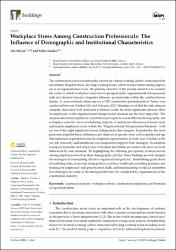
| dc.description.abstract | The construction sector is traditionally known for a harsh working culture characterized by uncertainty, frequent crises, and long working hours, which increase stress among employees at all organizational levels. The primary objective of the present research is to examine the extent to which workplace stress factors grouped under organisational/interpersonal, task and physical stressor categories influence professionals within the construction industry. A cross-sectional online survey of 185 construction professionals in Turkey was conducted between October 2024 and February 2025. Findings reveal that the task stressors category associated with increased workload exerts the most significant adverse effect on employees, while organisational/interpersonal stressors are the least impactful. The analysis also shows significant variations in perceptions across different demographic and workplace contexts. An overwhelming majority of significant differences between male and female employees occur within the "Organizational/Interpersonal Stressors", with six out of the eight significant factors falling under this category. In particular, the most pronounced gender-based differences are observed in specific areas such as gender and age discrimination in promotion and development opportunities at work, fear of failure at the job/job insecurity and insufficient encouragement/support from managers. In addition, young professionals and employees of medium sized firms are found to be more severely influenced by task stressors. By highlighting the differing perceptions of stress factors among employees based on their demographic profiles, these findings provide insights for managers in formulating effective organizational policies. Establishing goals about streamlining tasks, reviewing hiring policies to reduce workloads, providing guidance and training for employees' task prioritization skills, and implementing workload redistribution strategies are some of the strategies that may be considered by organisations in the construction industry. | en_US |
| dc.language.iso | eng | en_US |
| dc.publisher | MDPI | |
| dc.relation.ispartof | Buildings | en_US |
| dc.rights | info:eu-repo/semantics/closedAccess | en_US |
| dc.subject | construction sector | en_US |
| dc.subject | workplace stress | en_US |
| dc.subject | construction employees | en_US |
| dc.subject | job burnout | en_US |
| dc.subject | occupational stress | en_US |
| dc.title | Workplace Stress Among Construction Professionals: The Influence of Demographic and Institutional Characteristics | en_US |
| dc.type | article | en_US |
| dc.department | Fakülteler, Mimarlık Fakültesi, Mimarlık Bölümü | en_US |
| dc.institutionauthor | Gündeş, Selin | |
| dc.identifier.doi | 10.3390/buildings15244460 | en_US |
| dc.relation.publicationcategory | Makale - Uluslararası Hakemli Dergi - Kurum Öğretim Elemanı | en_US |
| dc.identifier.wos | WOS:001646948300001 | en_US |
| dc.identifier.scopus | 2-s2.0-105025968656 |
Bu öğenin dosyaları:
Bu öğe aşağıdaki koleksiyon(lar)da görünmektedir.
-
Տcopus [1664]
Scopus | Abstract and citation database -
Ꮃeb of Science [1868]
Web of Science platform